
Esta semana, Anthropic publicó un relato detallado de cómo construyeron analytics de datos self-service internamente usando Claude. Es una nota inusualmente honesta — y esa honestidad es lo que la hace valiosa. No porque muestre lo que Claude puede hacer, sino porque documenta lo que realmente costó hacerlo, y dónde están los límites.
La leímos con atención. Acá nuestra perspectiva.
1. El problema es real
Anthropic no publicó esta nota para hacer marketing de su producto. La publicó porque conectar IA con datos reales de negocio resultó ser genuinamente difícil — tan difícil que su propio equipo de ingeniería tuvo que construir un proyecto interno de infraestructura significativo solo para que funcionara para ellos mismos.
Vale la pena detenerse en eso. La empresa que construye los modelos de IA más capaces del mundo necesitó meses de trabajo especializado para responder sus propias preguntas de negocio de forma confiable. No porque Claude no sea poderoso. Sino porque el problema no es un problema de modelos. Es un problema de datos.
Si el laboratorio de IA líder en el mundo necesita invertir a este nivel para resolverlo por sí mismo, eso te dice algo fundamental sobre la naturaleza del desafío.
2. Los LLMs solos no pueden resolverlo — porque los datos no son software
Este no es un insight nuevo para nosotros. En 2021, leí el paper original de Transformers y probé GPT-2. Los modelos eran impresionantes — pero quedó inmediatamente claro que el problema difícil no era el modelo. Era el dato debajo. Esa se convirtió en la premisa fundacional de Teramot, y es lo que digo en cada pitch, en cada charla y en cada decisión de arquitectura desde entonces.
En junio de 2026, Anthropic lo publicó como título de sección en su propio blog. No es una coincidencia. Es una confirmación.
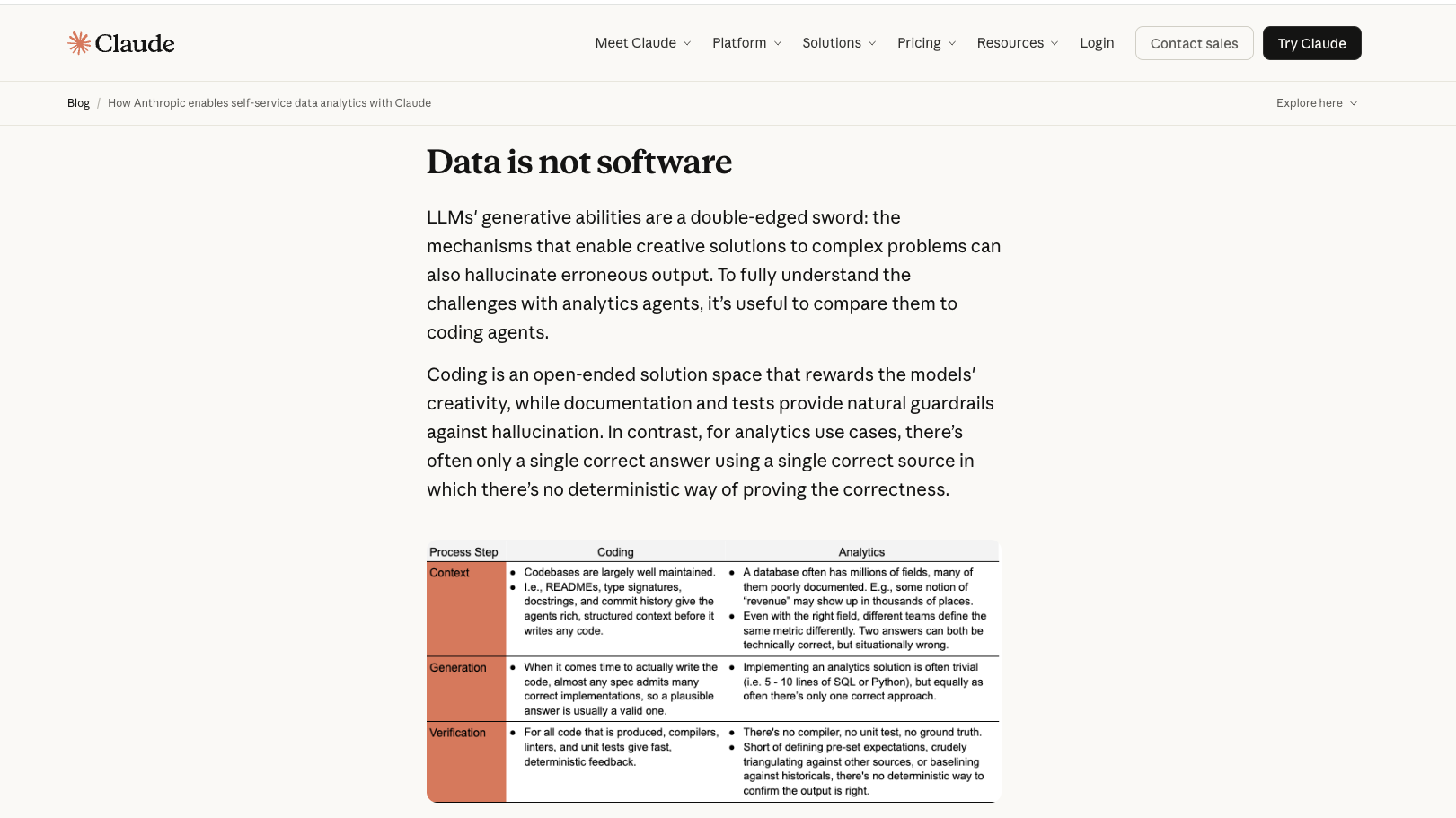
El código es determinístico y se autodescribe. Podés leer una función y entender qué hace. Los datos son diferentes. Llevan contexto de negocio, historia organizacional, ambigüedad y cambio constante que se acumula durante años dentro de una empresa. Un modelo — por más capaz que sea — no puede inferir qué significa “revenue” en tu contexto específico, a qué se refiere tu equipo cuando habla del “lanzamiento del Q2”, o por qué dos áreas calculan la misma métrica de forma diferente.
Anthropic probó esta suposición directamente. Cuando intentaron generar automáticamente su capa semántica usando LLMs — haciendo que el modelo auto-generara definiciones de métricas a partir de tablas y logs de queries — el resultado fue “net-negative on our evals versus a smaller, human-curated layer.” El modelo produjo definiciones que parecían correctas pero que codificaban exactamente las ambigüedades que querían eliminar.
No se puede hacer prompting para salir de un problema de datos.
3. Su solución requirió un equipo de primer nivel — y aún no están satisfechos
Lo que Anthropic construyó es técnicamente impresionante. Datasets canónicos gobernados, una capa semántica curada por humanos, un grafo de contexto de negocio con documentos indexados y estructura organizacional, artefactos colocados en capas con CI checks que protegen la integridad entre capas, y un footer de procedencia en cada respuesta que muestra de dónde vienen los datos y qué tan frescos son.
Esa es exactamente la arquitectura correcta. El problema es lo que costó construirla y mantenerla.
Requirió un equipo especializado trabajando durante varios meses. Cada cambio incremental en la metadata dispara ciclos de evaluación que tardan una hora cada uno y cuestan recursos significativos. Las skills necesitan revisarse y actualizarse cada mes a medida que la lógica de negocio y los modelos de datos evolucionan.
Y después de toda esa inversión, reportan 95% de accuracy en respuestas en producción — y son honestos en admitir que todavía no tienen una solución robusta para lo que llaman “silent failures”: los casos donde la respuesta es incorrecta, parece plausible, y se usa sin que nadie lo note. Una respuesta de cada veinte llegando a un líder sin ser detectada no es un sistema de producción. Es un prototipo muy bien construido.
4. Cada capa crítica requiere humanos en el loop
Quizás el detalle más revelador: después de toda la inversión en ingeniería, la supervisión humana sigue siendo estructuralmente necesaria en cada capa crítica.
La capa semántica no puede automatizarse — como sus propios experimentos demostraron, las definiciones generadas por modelos son peores que una capa más pequeña curada por humanos. La capa de contexto de negocio, que describen como “the layer most teams skip,” requiere curation humana continua para mantenerse al día con cómo el negocio realmente funciona. Cada respuesta destinada al liderazgo requiere aprobación humana explícita antes de ser utilizada.
Su conclusión es directa: generar documentación con IA, pero que un humano sea dueño de la definición.
Esa es la respuesta correcta para Anthropic. Ellos tienen el equipo para hacerlo funcionar. Pero plantea la pregunta obvia: ¿qué hace una empresa que no tiene ese equipo?
Para cualquier organización que quiera replicar lo que Anthropic construyó, la respuesta honesta es que necesita contratar y mantener un grupo dedicado de ingenieros especializados en datos e IA — no para construir el producto, sino solo para mantener la capa de datos con IA funcionando. Eso no es una estrategia de producto. Es un centro de costos. Y es uno que la mayoría de las empresas no puede sostener.
Qué significa esto — y cómo Teramot lo aborda de forma diferente
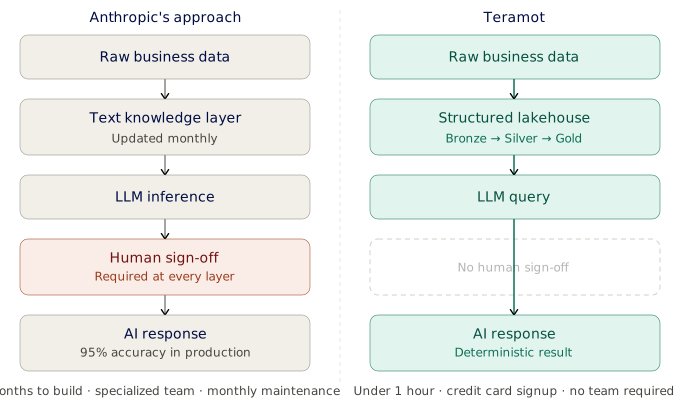
La arquitectura que Anthropic describe no está mal en sí misma. El problema es el modelo operativo que requiere.
La razón por la que su approach depende de mantenimiento humano continuo es estructural: construyeron una capa de IA sobre infraestructura de datos existente, y compensaron la falta de una fundación estructurada con skills, documentación de referencia y curation humana. Cuando los datos subyacentes cambian — lo cual ocurre constantemente — la capa de conocimiento basada en texto se desalinea, y los humanos tienen que realinearla.
Teramot empieza una capa más abajo. Antes de que nada llegue a un agente de IA, deployamos un data lakehouse completo — capas Bronze, Silver y Gold — donde cada transformación es SQL determinístico y toda la metadata vive en una base de datos relacional estructurada, no en archivos de texto. Una vez que esa fundación está en su lugar, la IA no infiere — consulta. El resultado es el mismo cada vez.
¿Esto requiere iteración humana para construirse? Sí — y creemos que eso es honesto. El conocimiento de negocio no emerge automáticamente. La diferencia es que con Teramot, esa iteración es rápida — típicamente menos de una hora para deployar una primera versión funcional, y cinco minutos para cada nueva iteración — y estable en el tiempo. No se reconstruye cada mes. Se construye una vez, y se mantiene. Porque el conocimiento es estructurado y relacional, los cambios en el modelo de datos se propagan correctamente en lugar de romper silenciosamente un archivo de texto en algún lugar aguas abajo.
Después de tres años de R&D y deployments en producción en empresas de América Latina, lanzamos en febrero de 2026 la versión que lo hace completamente self-serve: una empresa puede pasar de cero a un data lakehouse gobernado y listo para IA registrándose en nuestro sitio e ingresando una tarjeta de crédito. Sin onboarding de nuestra parte. Sin ingenieros especializados de su lado.
Lo que Anthropic describió es el problema correcto, resuelto de la manera correcta dadas sus restricciones. Lo que estamos construyendo es el mismo resultado — IA que realmente funciona con datos reales de negocio — diseñado para las empresas que no tienen el equipo de Anthropic.